3–7%
global prevalence — as common as dyslexia
Frontiers in Education, 2025 review
1 in 20
chool-age children meet criteria for developmental dyscalculia
Shalev et al.; Edublox 2025
1:1
boy-to-girl ratio – unlike dyslexia or ADHD, dyscalculia affects sexes equally
Shalev, PubMed
15×
less research funding than dyslexia, despite comparable prevalence
Rapin, Pediatric Neurology 2016
What Is Dyscalculia?
Dyscalculia is a specific learning difficulty that affects how the brain processes numerical and quantitative information. It is not a problem of intelligence, motivation, or maths teaching quality.
At its core, dyscalculia involves differences in the intraparietal sulcus – the brain region that represents quantity and magnitude. People with dyscalculia struggle to develop a stable “number sense”: the intuition that 7 is more than 5, that 14 sits between 10 and 20, that a half is bigger than a third. Without that foundation, every later skill (arithmetic facts, place value, fractions, algebra) is being built on sand.
Dyscalculia runs in families. It is lifelong, distinct from maths anxiety, and entirely separate from general low attainment in maths. The difference matters: anxiety responds to confidence-building and good teaching. Dyscalculia requires structured, multisensory, evidence-informed support.
“Dyscalculia is a specific and persistent disorder of numerical-arithmetical skill learning that manifests with profound difficulties in the acquisition of basic numerical skills, despite normal intelligence and adequate schooling.”
– ICD-11, World Health Organization (2022) / DSM-5-TR alignment
Number Sense Difference
The intraparietal sulcus shows reduced grey matter and atypical activation during numerical tasks. This is a brain-based difference, not a teaching gap.
Lifelong, Not Outgrown
Without targeted support, dyscalculia persists into adulthood – affecting budgeting, time management, medication dosing, and career options.
Genetic Component
Forty-two percent of children with dyscalculia have a first-degree relative with a learning difference. Heritability is established and significant.
Distinct from Maths Anxiety
Maths anxiety is an emotional response that often follows undiagnosed dyscalculia. The two coexist, but they require different interventions. Confusing them wastes years.
How Common Is Dyscalculia?
Dyscalculia is roughly as common as dyslexia. Yet PubMed lists fifteen times more papers on dyslexia than on dyscalculia. The science exists. The recognition does not – yet.
3–7%
global prevalence among children and adults — comparable to dyslexia, ADHD, and SLI
Scientific American; Shalev et al.
5%
of U.S. children carry a developmental dyscalculia profile
SAGE Journals; NCLD 2024
7.6%
prevalence in Brazilian school-age cohort — one of the largest international samples
District Administration; Brazilian cohort study
42%
of children with dyscalculia have a first-degree relative with a learning difference
PubMed; Shalev developmental cohort
The Three Faces of Dyscalculia
Dyscalculia is not one condition. Researchers distinguish at least three cognitive profiles. Knowing which profile a learner has changes the intervention plan entirely.
Core Number Sense Deficit
The most fundamental and most studied form. Difficulty representing quantity itself – the “feel” for how big a number is, how many dots are in a set, which of two numbers is larger.
Predominantly Inattentive
Difficulty sustaining attention, following through on tasks, organising work, and holding information in mind. Often quiet, internally distracted, daydreamy. Most commonly missed in girls and women.
Predominantly Hyperactive-Impulsive
Restlessness, fidgeting, blurting out, interrupting, difficulty waiting. More common in young children and more visible to teachers and parents – leading to earlier referral.
How Dyscalculia Shows Up Across the Lifespan
Signs evolve with age. Early identification at any stage opens the door to effective support – and dyscalculia is identifiable from as early as age five.
Early Signs (Ages 4–6)
Dyscalculia leaves fingerprints before formal arithmetic begins. These pre-numeracy markers – particularly subitising accuracy and counting fluency – predict maths trajectory through primary school with high reliability.
Cannot subitise – has to count one, two, three even on small dot sets
Difficulty learning the count sequence past 10
Skips numbers or repeats them when counting objects
Cannot answer “which is more” between two visible sets
Trouble matching written digits to spoken number words
Avoids board games involving dice or counting spaces
Early Predictive Markers (ages 5–6)
School-Age Signs (Ages 7–12)
Once arithmetic instruction begins in earnest, dyscalculia becomes unmissable to anyone trained to see it. The gap is not laziness, not poor teaching, and not anxiety – though all three may follow as consequences if the underlying cause goes unrecognised.
Persistent finger counting well into ages 8 to 10
Cannot retain times tables despite repeated drilling
Misreads digits (writes 17 for 71, or 6 for 9)
Struggles with telling time on an analogue clock
Difficulty with money, change, and value comparisons
Place value confusion – does not grasp why 23 differs from 32
Strong verbal reasoning but written maths falls apart
Challenges in School-Age Children with Dyscalculia
Teen & Adult Signs
Dyscalculia is the great undiagnosed adult learning difference. Most adults with it grew up believing they were “bad at maths” – never knowing that a recognised neurological condition explained the gap. Workplace and financial demands frequently expose what schooling missed.
Persistent difficulty with budgeting, tipping, and mental arithmetic
Time blindness – chronically late, misjudges trip duration
Avoidance of careers, courses, or tasks involving numbers
Anxiety, panic, or shutdown when faced with numerical problems
Trouble remembering phone numbers, PINs, dates
Reliance on calculators for tasks others do in their head
Adult Dyscalculia Self-Reported Impact
The Three Core Cognitive Deficits
Decades of neuroimaging and cognitive research, summarised in Pediatric Neurology and Frontiers in Education, point to three systems that operate differently in dyscalculic brains.
01
Approximate Number System
The intuitive, non-verbal sense of quantity shared with infants, primates, and birds. It tells you at a glance that ten is “more” than three, without counting. In dyscalculia, this system is noisier, less precise, and slower to map onto digit symbols.
The quantity intuition
02
Symbol-Quantity Mapping
The bridge between the digit “5” and the felt sense of fiveness. Neuroimaging shows weaker activation in the intraparietal sulcus when dyscalculic children process symbolic numbers – the very translation step that makes arithmetic possible.
The bridge that buckles
03
Working Memory for Number
The mental space that holds numbers while you operate on them. Children with dyscalculia show reduced intraparietal-sulcus activation during numerical working memory tasks. Multi-step problems collapse because the numbers slip out of the workspace.
The workspace that empties
Dyscalculia Rarely Travels Alone
Most children with dyscalculia carry at least one additional learning difference. The 2025 Frontiers in Education review identifies dyscalculia-dyslexia comorbidity as one of the most under-served populations in education – children whose double profile is rarely screened in full.
Screening for dyscalculia in isolation misses the larger picture. Screening for maths difficulty alongside reading, attention, and visual processing produces a profile that actually predicts outcome.
~40%
co-occurrence of dyscalculia and dyslexia – the most common pairing in the learning-differences space
26%
of children with dyscalculia also meet ADHD criteria – and the reverse pattern is similar
71%
of adults with dyscalculia report clinically significant maths anxiety as a downstream consequence
EMA – Evaluation of Math Ability
A 360° cognitive profile of mathematical learning. The EMA goes beyond “right or wrong” answers to the underlying cognitive systems — number sense, math facts, reasoning, visual processing, working memory, and rapid naming – that determine why a learner struggles, not just how much.
EMA detects dyscalculia subtypes and math processing risks early, then links results directly to targeted, classroom-ready interventions. Built for MTSS/RTI teams, educational psychologists, and learning specialists who need to know why – not just how much.
Number Sense
Foundational understanding of quantities, order, and numerical relationships. The earliest indicator of dyscalculia risk.
Math Facts & Fluency
Automatic retrieval of basic operations. When this fails, working memory has nothing left for problem-solving.
Visual Processing & Subitising
Visual-spatial and pattern skills critical for quantity perception, geometry, and place value comprehension.
Working Memory
Capacity to hold and manipulate numbers in mind during multi-step problem solving – the mental workspace.
Math Reasoning
Application of concepts in real problems and curriculum-linked reasoning demands – word problems, logic, conceptual understanding.
Rapid Automatised Naming
Speed of visual-verbal association that predicts fluency in both reading and maths, flagging co-occurring risks early.
What Actually Works
The evidence converges: structured, multisensory, concrete-to-abstract instruction – delivered by trained specialists, started early, and matched to the learner’s specific cognitive profile. Generic maths practice does not move the needle.
01
Concrete → Pictorial → Abstract
The CPA progression. Every new concept is introduced first with physical manipulatives, then with diagrams, then with symbols. Skipping a stage is the most common cause of failed maths instruction.
02
Multisensory Number Sense Building
Numicon, Cuisenaire rods, dot patterns, number lines, ten frames. The cognitive deficit is in quantity representation. The intervention rebuilds that representation through every available sensory channel.
03
Explicit Fact Strategies
Forget rote memorisation of times tables. Teach the strategies – doubles, near-doubles, decomposition, derived facts. Children with dyscalculia can master arithmetic if the strategies are made explicit and patterns visible.
04
Reduce Working Memory Load
Provide reference charts, calculators, formula sheets. The math skill is the concept, not the recall. Removing the working memory burden lets the conceptual thinking actually happen.
05
Address Maths Anxiety in Parallel
Years of unrecognised dyscalculia create a panic response to numbers. Confidence-building, growth-mindset framing, and small structured wins must run alongside the cognitive intervention – not after it.
06
Statutory Accommodations
Extra time, calculator access, formula sheets, reduced question counts in tests. These are not advantages. They level the cognitive playing field and are recognised in IEP, 504, and EHCP frameworks across jurisdictions.
Dyscalculia Screening & Assessment
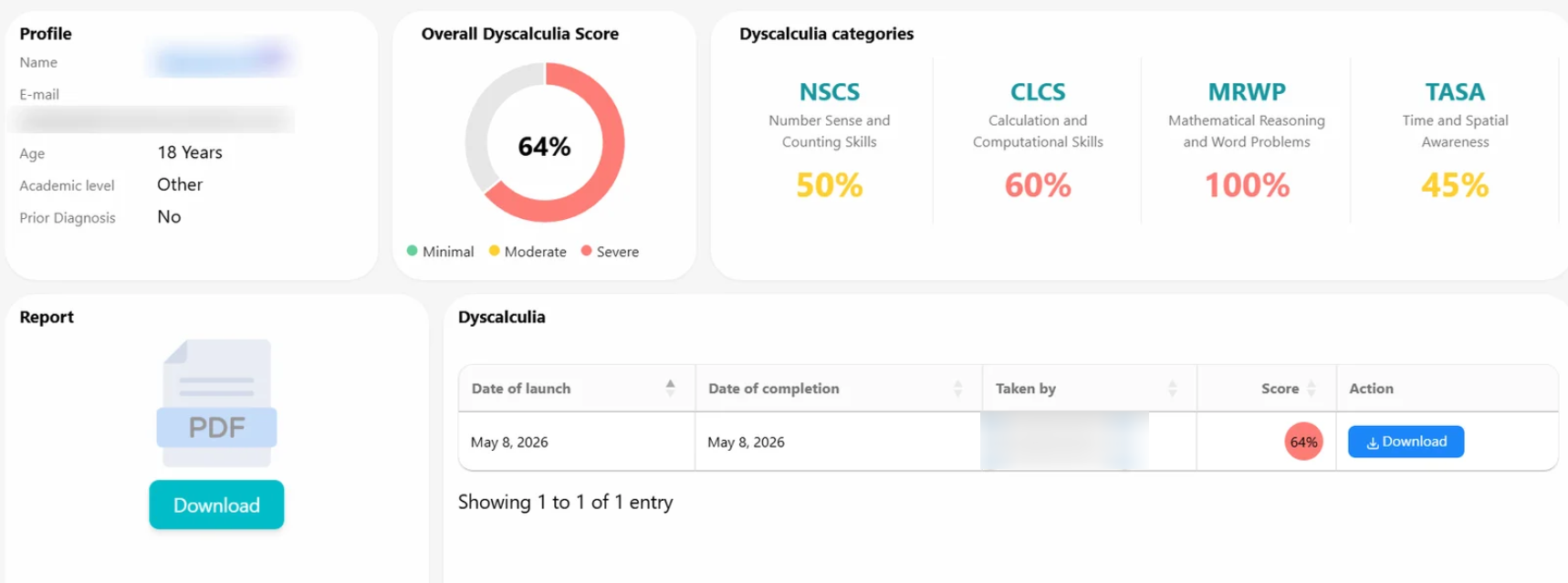
From a quick free check to the EMA, MyMemoryMentor’s clinician-grade comprehensive Dyscalculia Screening Test – choose what fits your situation.
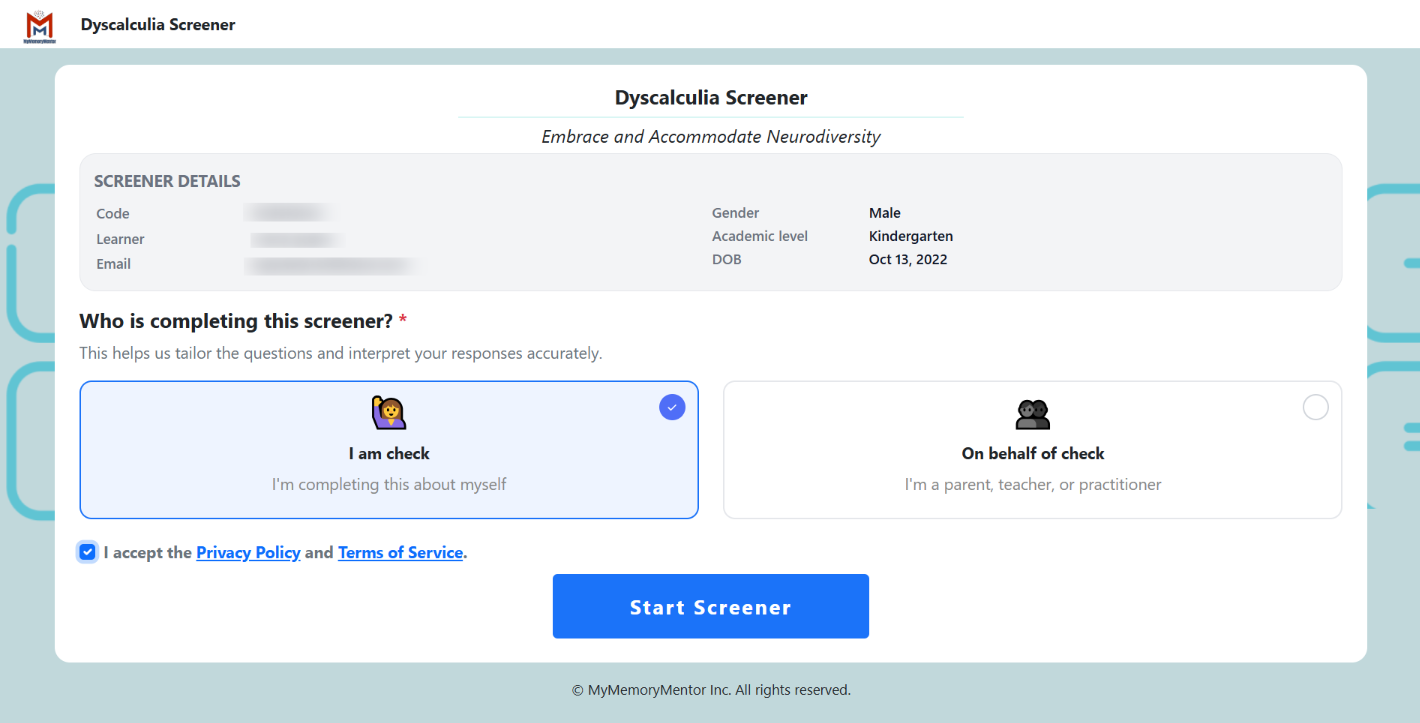
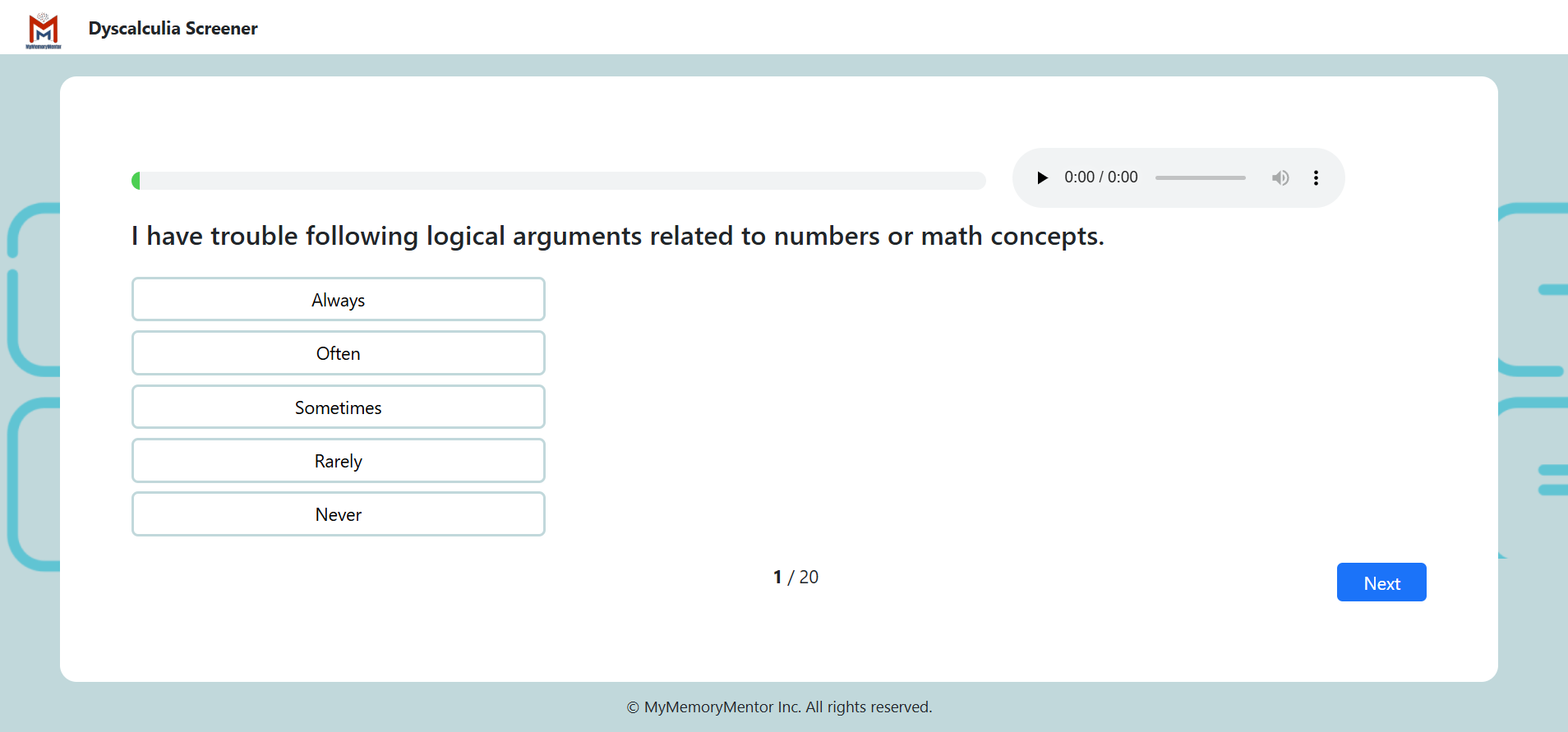
Free Dyscalculia Screener
A fast, validated questionnaire that identifies likely number sense deficits and maths processing risk. Ideal for parents, teachers, MTSS coordinators, and self-referral.
- Free – no account required to start
- Covers core number sense, subitising, and arithmetic markers
- Available for ages 5 through adult
- Results with plain-language explanations in under 10 minutes
- Categorised into challenge tags for targeted intervention
- Aligned with DSM-5-TR and ICD-11 criteria
MOST COMPREHENSIVE
EMA – Evaluation of Math Ability
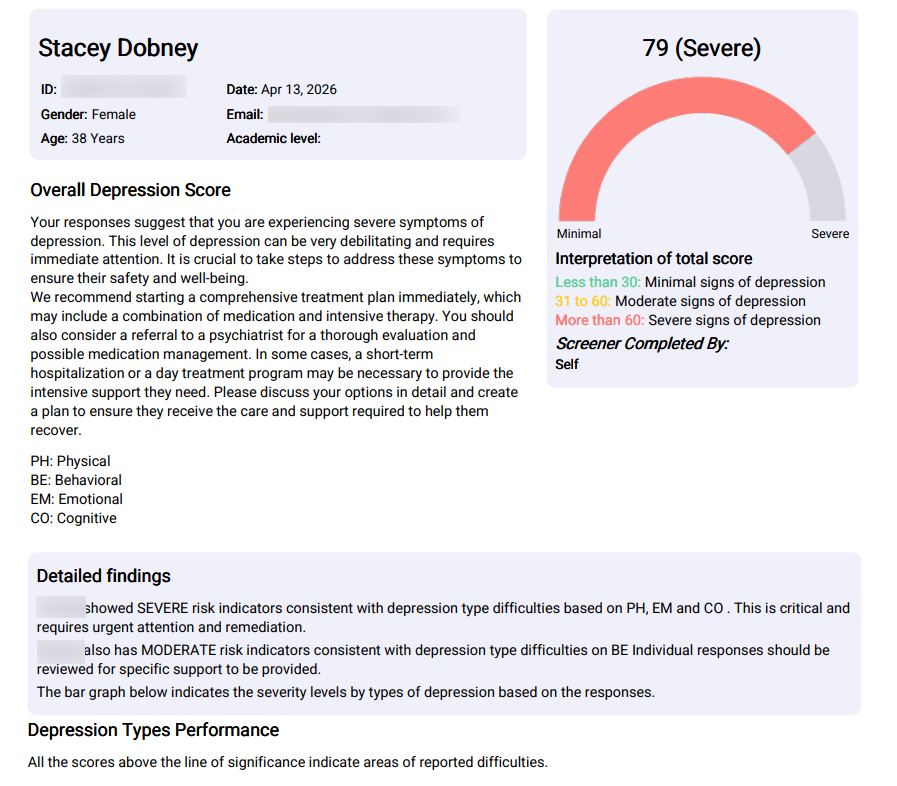
MyMemoryMentor’s psychometrically validated comprehensive math assessment measuring all six cognitive foundations of mathematical learning – producing a full diagnostic-grade profile with classroom-ready intervention recommendations.
- Six cognitive domains: number sense, fluency, visual processing, working memory, reasoning, RAN
- Identifies dyscalculia subtype and processing pattern
- Ranked test performance with strengths and risk flags
- Multi-sensory, concrete intervention recommendations included
- Suitable for IEP, 504, EHCP, and MTSS/RTI submissions
- Parent- and teacher-friendly report language
- GDPR and HIPAA-aligned data handling
Dyscalculia Myths vs. Facts
Misconceptions delay identification. Here is what the research actually shows.
Myth
“They’re just bad at maths.”
Fact
Dyscalculia is a recognised neurodevelopmental condition with consistent neuroimaging evidence of altered intraparietal sulcus function. It is not a matter of effort, intelligence, or teaching quality.
Myth
“More practice will fix it.”
Fact
Generic maths drilling does not address the underlying number-sense deficit. Children with dyscalculia need structured, concrete-to-abstract, multisensory intervention. Without it, more practice produces more frustration, not more learning.
Myth
“Dyscalculia is just math anxiety.”
Fact
They are distinct conditions that often coexist. Math anxiety is an emotional response; dyscalculia is a cognitive processing difference. Most adults with dyscalculia develop math anxiety as a consequence of years of unrecognised struggle.
Myth
“Dyscalculia only affects boys.”
Fact
Unlike dyslexia and ADHD, dyscalculia affects boys and girls at roughly equal rates. The Shalev developmental cohort confirmed an approximately 1:1 ratio. There is no biological gender protection here – only equal under-identification.
Myth
“Children outgrow dyscalculia with age.”
Fact
Dyscalculia is lifelong. Without targeted support, the maths gap widens through schooling and persists into adulthood – affecting budgeting, medication dosing, career choices, and confidence. Early intervention changes the trajectory significantly.
Myth
“Dyslexia only affects boys.”
Fact
Dyscalculia is entirely independent of reading ability. Many people with dyscalculia have strong verbal reasoning, vocabulary, and literacy skills. The cognitive systems for number and for language are largely separate. Being articulate does not rule it out.
Stop Calling It “Bad at Maths”
A free screening takes less than 10 minutes. For comprehensive insight, EMA provides a six-domain cognitive profile. Early identification rewrites the story – for children still in school, for teenagers losing confidence, and for the adults who quietly suspected for decades.